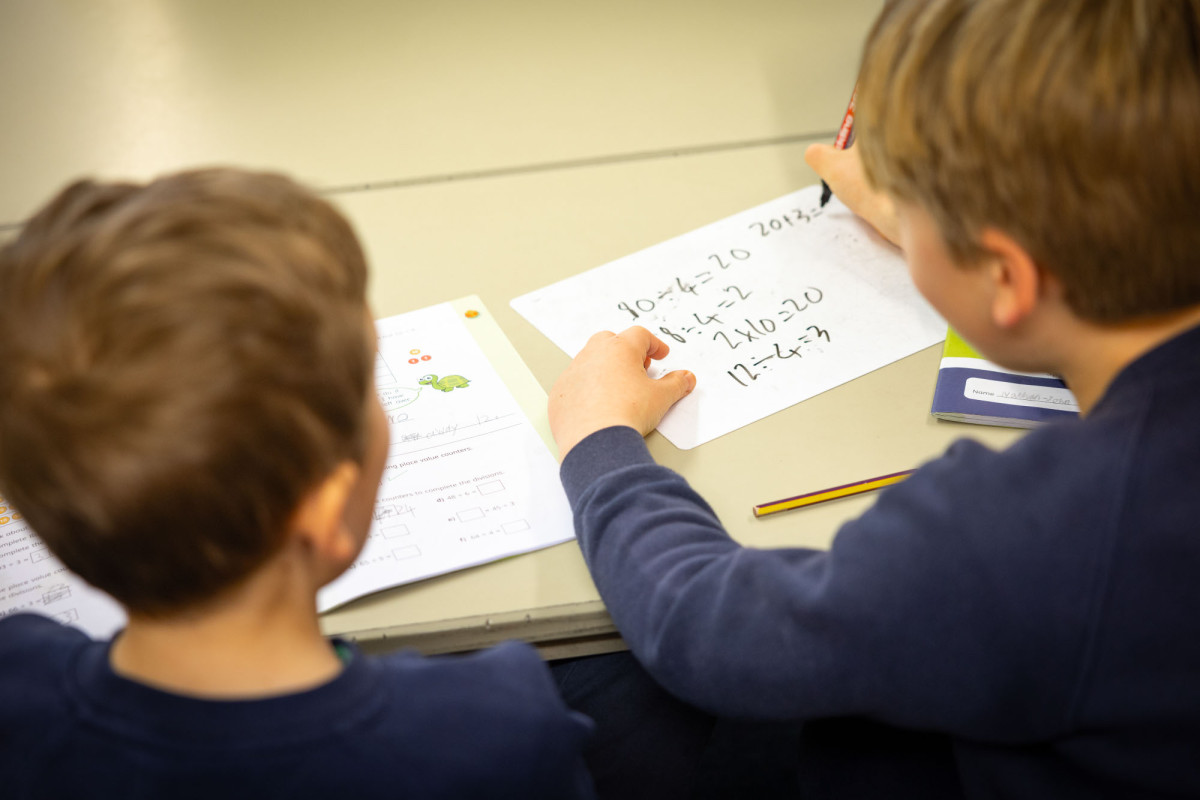
We believe that the basic skills of mathematics are vital for the life opportunities of our children. We want all our children to think mathematically, enabling them to reason, solve problems and assess risk in a range of contexts.
We strive to enable fascination and an excitement to discover mathematical concepts and to broaden children’s knowledge and understanding of how mathematics is used in the wider world.
Our aim is to ensure children have transferable mathematical skills, the ability to reason and solve problems, and a well-developed vocabulary. We believe that the language of mathematics is international. We provide children with the opportunity to explore mathematics using a range of concrete, abstract and pictorial resources.
Solving problems using numerical fluency is the basis of our mathematical lessons. We hope children experience a sense of awe and wonder as they solve a problem for the first time. We strive to ensure that children leave Chinley Primary School with a logical and creative number fluency and with an ability to recall key number facts such as multiplication tables.
We know that this is the strongest foundation we can give our children as their use of mathematics becomes more sophisticated.
We believe that all children should have:
· A deep understanding of maths and number.
· A positive and resilient attitude towards mathematics and an awareness of the fascination of mathematics.
· Competence and confidence in mathematical knowledge, concepts and skills.
· An ability to solve problems, to reason, to think logically and to work systematically and accurately.
· A range of learning strategies – working both collaboratively and independently.
· Fluency in mathematics where children can express ideas confidently and talk about the subject using mathematical language.
· An understanding of the importance of mathematics in everyday life.
· Opportunities to become independent learners who take responsibility for their own learning.
Challenge is built into every lesson for pupils who grasp concepts rapidly through sophisticated problems and an opportunity for children to demonstrate their understanding creating their own problems.
Our mastery approach to the curriculum is designed to develop children’s knowledge and understanding of mathematical concepts from the Early Years through to the end of Year 6. As a school, from Year 1 onwards, we follow the White Rose scheme of learning which divides blocks of knowledge into small learning steps.
Within the Early Years Mathematics curriculum, there are two Early Learning Goals. We strongly focus on the importance of embedding a deep understanding of number to 10, including the patterns and relationships between these numbers and developing spatial reasoning skills. Our children are encouraged to develop a positive attitude to and interest in maths, not being afraid to make mistakes.
What does the maths lesson look like outside the classroom?
We believe that an important part of teaching maths is to recognise the opportunities the natural world provides. Such opportunities include mark making (with the younger children), teaching measurement, statistics, position and direction.
Useful websites:
To find out more information about our scheme of learning click here:


